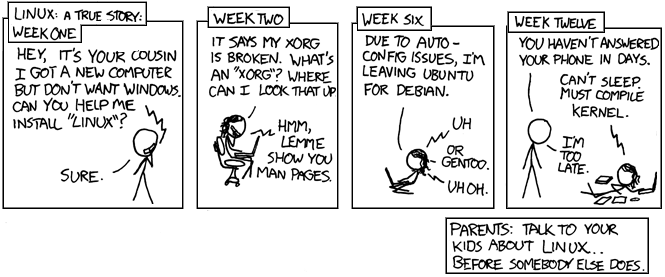
Linux - Hehe
Miscellaneous Forums/General Discussion/Linux - Hehe
It's true, the thing a lot of Linux fanboi's forget is that most of us don't want to have to think about our OS, or what or how it does it. When you use an OS as a user desktop you just need it to work and run the applications. For most people time spent tinkering with their OS is not fun, or useful it's just wasted time...
Darkheart
LOL
Here we go again...
/agree
I want to focus on using the programs and writing games without caring about operating system issues. Windows might be big and clunky, but at least it's a standard you can rely on people having.
I agree. An OS should be seamlessly functional, with absolutely minimal need to configure or tinker with it to get it working. In this respect Mac OSX is even better than Windows (automatic file defragmentation, etc.)
Linux has two major flaws IMO:
1. Way too many incompatible distributions. It's like "Linux" is like a thousand different operating systems, each incompatible with each other in little ways. This alone kills Linux as an option for a home OS for the average user. Optimally, there should be just one distribution of Linux for desktops/laptops (there can be others for phones, PDAs, and non-standard devices of course). This way the Linux community can work towards a common goal, and easily "defeat" both Windows and Mac OSX.
2. Similar to #1, Linux distributions have too many target processor types. This means you must either distribute software as source code which the user has to compile (ugh), or compile your software 10 different times for 10 different target architectures (and worry about the 11nth not working). Really, it wouldn't be all that far fetched to compile an OS for 64-bit x86-based processors only. All modern CPUs are 64 bit anyway.
It's sad, really, because Linux could be a lot better than it is, but the scattered-ness of it's PC distributions makes "Linux" impossible to compete with Windows / Mac, where with a unified Linux distribution it could easily compete.
Steve Jobs once said about OS/2 that "people don't use operating systems, they use applications". He also said that he didn't care what CPU powers his computer. If it was up to him, it could as well be a hamster running in a wheel, as long as he could still do whatever he wants with the machine.
Steve Jobs once said about OS/2 that "people don't use operating systems, they use applications". He also said that he didn't care what CPU powers his computer. If it was up to him, it could as well be a hamster running in a wheel, as long as he could still do whatever he wants with the machine.
I agree 100%.
Haha Very clever.
I dont tinker with it, never had to compile anything (except my stuff) and i only use it because its simply better, smoother and less annoying.
Btw, EVERYONE has OS issues if they dont know what their doing, regardless of the system. Problem with the usual MS fanboi linux bashers is they dont know what they are doing with it so it MUST be crap. How long did it take you to get to your current standard in windows? If my mum can use ubuntu and have no problems (someone who cant even use the video) then some people have no excuse. You cant run before you can walk.
You could redraw that cartoon for a windows noob too:
Week One:
-Hey its your cousin, ive just got a new machine and cant use it, can you help?
-Sure
Week Two:
-I just tried to install something and now the PC wont start.
-Just go into safe mode and remove the program from control panel.
-Eh? Whats that?
Week Six:
-Due to a cronic bluescreen and constant memory errors i need to re-install it. Can you come round and help me?
-Sure, got your OEM disk?
-Whats that?
-The software that came with it.
-No, i threw them out because they were already installed.
Week 12:
-Cant sleep, need to re install again because my PCs infected and nothing can clean it up.
It sounds to me like in week two and six your cartoon guy broke something himself because he had no clue. Hardly the systems fault.
I took the bait didnt I!
Damn you DH !!! :P)
How long did it take you to get to your current standard in windows?
All I know is I was able to do everything I wanted to do, and more, right out of the box. I was installing games from CDs, downloading apps from the Internet, and even programming my own apps. I like to customize my PC by installing apps and games I like, not by editing the OS kernel and using shell commands to find out why my wireless access card isn't working.
I know there's a lot of effort to make Linux user friendly, but no unified distribution / architecture means that every app must be compiled per-machine - this means you'll either have to distribute your source (not user friendly, and doesn't work for commercial software), or you'll have to compile for 100 different distribution / architecture combinations (a waste of time and effort).
I mean, if there was a unified Linux distribution / architecture, I'd probably even contribute to it. At least I'd be helping work towards a common goal, and I'd know that my efforts won't be wasted when my distribution of Linux becomes obsolete.
D4NMAN, Vista/XP is not unstable, Windows stopped being an unstable OS with the demise of 9x, your living in the past. I can't remember the last time I heard someone complaining about bluescreens or memory errors with Windows, however Linux is still as impenetrable to Joe Public as ever.
Darkheart
All I know is I was able to do everything I wanted to do, and more, right out of the box.
So could I pretty much. I simply installed it and ticked a load of software i wanted to install from a list. I have been using windows since V2 so cant say myself how 'easy' it is.
I am an windows IT engineer and work with windows noobs all the time and none would even come close to doing what you are saying you did with it straight away. You must have had previous experience with a previous version. If you say DOS then all i can say is you have forgotten just how many problems with hardware and compatibility 3.1 actually had (no PnP for a start!). Most games wouldn't even run in 3.1.
not by editing the OS kernel and using shell commands to find out why my wireless access card isn't working.
Ive been using it for 3 years and the only 1 time i have messed with the kernel was simply for interest, not out of necessity. Anyway, would you wonder why OSX wouldn't work with your wireless card too?
Hardware is either capable or it isn't.
D4NMAN, Vista/XP is not unstable, Windows stopped being an unstable OS with the demise of 9x, your living in the past. I can't remember the last time I heard someone complaining about bluescreens or memory errors with Windows, however Linux is still as impenetrable to Joe Public as ever.
Darkheart, you are forgetting I AM a windows user both at home (XP/Vista) and at work as an engineer .
Our support team at work gets at least 2 bluescreens a week to go out and fix. Usually caused by rolled-out driver or windows updates. No, im not living in the past as you say. To say instability ended with 98 though is just mad. Only since SP2 has XP been more stable. Ive had more bluescreens with XP than with any other -since win95 (didnt use ME)
XP IS good -now- after 3 service packs, i just dont think its as good as Ubuntu, but thats my opinion. Vista seems secure enough now but i dont like the interface at all, and have had a fair few problems with it which after a lot of reading have mostly fixed.
As for joe public, they should stick with windows unless they buy a 100% linux capable machine which just works.
Windows:
Day 1
It works.
I never defrag or do any maintainence.
I think there was some serious consideration of Linux around the time Vista came out, and now there is a huge backlash against it because so many people tried it and found out all the fanboy talk was a lie.
Scenario:
A casual computer user who just dabbles in email, web surfing, porn, MySpace and YouTube...what is their best OS option?
Answer: Ubuntu.
A person using a PC for the above activity (i.e. 70% of home computer users) would have a Windows system so infected and bogged-down with Trojans and spyware after 2 months that the machine would be unusable.
You just don't have this with a Linux system. Plus Linux is free. I tell everyone I know: if you are just doing email, surfing the net, ripping music and watching movies- use Ubuntu and stay away from Windows. Also, Ubuntu installs as easy as Vista and has OpenOffice, a full-feature email client, and a ton of other great software available as soon as you hit the desktop.
Windows is great for businesses, developers, gamers and the like, but the casual market - i.e. a majority of home users - would benefit to move to Ubuntu.
Yawn...
I like A, you like B. You stick with B, I'll stick with A. My friend is happy with C.
Great, everyone is happy.
It works.
Well.. so does ubuntu, and it usually stays working. :P
I never defrag or do any maintainence.
I do, i defrag my windows about once every 2 months, otherwise it starts to get noticeably slower after about 5-6.
I simply installed it and ticked a load of software i wanted to install from a list.
My original point still stands (ignored) - because you practically have to distribute all apps as source on Linux, there's not much chance for commercial software to survive, and not much chance that even I would want to develop free software because I like to provide my users with nice, easy to use installer applications, rather than throwing some source files at them and expecting them to resolve dependencies and figure out how to compile it (or I guess I could supply a 20 page how-to-compile manual, but do you get my point?).
Our support team at work gets at least 2 bluescreens a week to go out and fix. Usually caused by rolled-out driver or windows updates. No, im not living in the past as you say. To say instability ended with 98 though is just mad. Only since SP2 has XP been more stable. Ive had more bluescreens with XP than with any other -since win95 (didnt use ME)
You must have some pretty bad driver support. If you get better supported hardware from well known companies, you shouldn't have these problems.
XP IS good -now- after 3 service packs, i just dont think its as good as Ubuntu, but thats my opinion.
When I installed Ubuntu, it seems that 20% of the applications included with it locked up often (forcing me to terminate them). On top of all that, after about 5 to 10 minutes of using it, my computer would just lock up COMPLETELY. No mouse movement, no keyboard, nothing. I had to force restart. After this happened consistently (every single time), I removed Ubuntu.
XP, on the other hand, has never ONCE frozen on me like Ubuntu, and when applications crash, the system recovers flawlessly (no need to restart). No driver issues, everything works perfectly.
because you practically have to distribute all apps as source on Linux
EH!? Dunno what backend distro you were using but with the main ones they have these things called packages. As i said before ive never needed to compile anything on Ubuntu. Simply installed the binary.
I had to force restart.
Why? Thats just the X server, not the linux kernel. Ctrl+Alt+F1 is monitored independently and allows you to kill off the offending app, then ctrl+alt+f6 back into gnome. This has NEVER failed on the VERY rare occasion this has happened to me. I have never experienced the problems you have on any of my 6 machines.
Why? Thats just the X server, not the linux kernel. Ctrl+Alt+F1 is monitored independently and allows you to kill off the offending app, then ctrl+alt+f6 back into gnome. This has NEVER failed on the VERY rare occasion this has happened to me. I have never experienced the problems you have on any of my 6 machines.
That didn't work - there was no offending app in particular that was "keeping" things frozen - it was a system-wide crash. Remember I said even the mouse stopped responding. The entire system froze, as though Ubuntu did something to mess up my motherboard or CPU.
because you practically have to distribute all apps as source on Linux
EH!? Dunno what backend distro you were using but with the main ones they have these things called packages. As i said before ive never needed to compile anything on Ubuntu. Simply installed the binary.
I used Ubuntu. Yeah, it's nice when you can find software specifically intended for your version of Ubuntu (32/64 bit), but if you can't then you pretty much have to compile from source. This leads to my original and main point about linux: it needs a unified distribution / target architecture.
You must have some pretty bad driver support.
Not really its all IBM, HP and Dell & there is about 1000 PCs on site.
What brucey said.We will just have to agree to disagree.
These arguments are pointless because they just go on and on. Ive been using windows for about 18 years (all versions not ME) and Ubuntu for three, so i know which i prefer. Its nothing to do with politics, its simply better
IMO
We will just have to agree to disagree.
I agree it's pointless to argue about opinions, but there still a very important non-subjective topic that can be discussed, and that is the fact that Linux is very scattered. Whether you like it or not, it's the divided nature of all the Linux distributions that it keeping Linux behind Windows / Mac in terms of ease of use.
"People don't use operating systems, they use applications". As I said before, I, and many other software developers, would gladly develop software for Linux if there weren't hundreds of distribution / target architecture combinations to support. This is possible if you release your source code, but again, this not only is this impossible for commercial software, but it makes life hard for the user (and it makes it impossible for you to use commercial 3rd party libs, etc.)
Windows ppl have problems with MacOS and Linux, and thus they run Windows
Linux ppl have problems with MacOS and Windows, and thus they run Linux
MacOS ppl have problems with Linux and Windows, and thus they run MacOS
I think each OS has its benefits and doubts... I also think that we could go on for days arguing on which one is best (I think they should have a world record of the longest discusion regarding this). And as brucey said, as long as you're happy with your OS, thats all the matters right?
Here's my opinion:
I personaly don't like mac, not because its a bad OS but because I can't stand the single click mouse.
Most of my machines are windows, with the exception of one that is running Xubuntu Linux.
I like windows because:
A. Its ready to go out of the box, and
B. I'm used to it.
I like Xubuntu because:
A. Its similar to windows, except for the foriegn linux file system, and
B. Its extremely simple, with the ability to fully customize.
CS_TBL: More like this:
Windows ppl have problems with MacOS and Linux, and thus they run Windows. Windows people write Windows apps.
MacOS ppl have problems with Linux and Windows, and thus they run MacOS. MacOS people write MacOS apps.
Ubuntu ppl have problems with MacOS and Windows and other Linux distros, and thus they run Ubuntu. Ubuntu people write Ubuntu apps.
Red Hat ppl have problems with MacOS and Windows and other Linux distros, and thus they run Red Hat. Red Hat people write Red Hat apps.
Fedora ppl have problems with MacOS and Windows and other Linux distros, and thus they run Fedora. Fedora people write Fedora apps.
Knoppix ppl have problems with MacOS and Windows and other Linux distros, and thus they run Knoppix. Knoppix people write Knoppix apps.
Gentoo ppl have problems with MacOS and Windows and other Linux distros, and thus they run Gentoo. Gentoo people write Gentoo apps.
(+ 100 others)
Windows is currently #1, with Mac at #2. If Linux is going to compete, all the distributions need to join forces and work towards a common goal.
I can't stand the single click mouse.
I'm currently using a plain-old Logitech optical mouse. It has two buttons no less, and when you click the right mouse button, up pops the context menu.
There must be other things you don't like then, as I've been using two-button mice since OS X came out.
I can't stand the single click mouse.
One of the reasons I don't bother with Apple (and iTunes is pathetic, I get occasional spam for iTunes - even though I've never owned an Apple product).
What is the point of this thread exactly?
>What is the point of this thread exactly?
Apparently to make fun of linux and spark a war :)
The point was a funny satire....
It's worth noting that the author's comments (the author of the comic) said that this was a true story, and that his sister's wifi still doesn't work to this day so he doesn't fear she will read the comic he publishes regularly...
@D4NM4N
Yeah, sorry about this. Got you stuck in another os debate ;-)
I guess the ultimate point is that I personally like linux, for simple stuff like you said. Anything advanced and you practically have to live at your pc for a few years filling jars of urine and paying someone to empty them for you.
There are many valid points though. If the flavors were to join forces and come to a standard with many of the inconsistencies, linux would be a very competitive product.
Mac has always had 3 button support (since osx), but every time you want something mac, you have to deal with Apple.... Why is that bad? Because Apple is EXACTLY what they had always preached against with 'big brother IBM'. They build it, they distribute it, they lic it. Just look at this crap with the iPhone.... I can't get one unless I go to THEM.... Mr. Jobs used to call IBM big brother, and speak out against them in his commercials and what not. Now Apple is big brother... They wont let you do anything 3rd party anymore (3rd party support on ipod? nope, not officially supported).
Windows has it's issues a plenty. But the bottom line is that it's number #1 with consumers of the desktop market (non-server). It works out of the box, and I don't need M$'s permission to build a new pc of 3rd party parts for it to run on. Hell, I don't ever have to see a M$ agent/sales person to use it or even buy it. They don't give me the mud slinging commercials which although I consider funny, I still think they are down right childish. It's like watching a smaller kid on the playground call the bigger kids names behind their backs in hopes of gaining support on them getting picked not-last....
M$ takes their beating from everyone, they usually add features which are commonly asked of them, and still want us to generally succeed with their os. Mac doesn't really care if we succeed, they care if Steve likes it or not. Steve is like the spoiled kid with his bell. As long as he likes it he assumes 90% of the market will, in fact he banks on it, he preys of morons in many cases. Linux? Yeah, here's an os that everyone thinks they can "rebuild" themselves... "Hey, I have an idea of a feature to add, I'll make my own linux flavor and I'll be popular too!". It's a great idea, but everytime the hardware changes I have to sit around and wait till the 3rd party guys build drivers for me and my flavor. That is if they haven't lost interest and abandoned the project... In which case I dont have to wait, I can just build my own. By the time I do that I have just learned enough useless linux tips and tricks that I am now unable to move from my chair as atrophy has set into my muscles.
hehe
Yeah, only that Linux developers don't give a shit about consumers. OSS developers who work for free only scratch their own itches, and the paid ones work on some enterprise level stuff where their employers make money. GNU/Linux hasn't managed to become a consumer compatible system in the last 15 years.
Apple certainly does not care about geeks or developers. You are not their audience and target market. They care about consumers and non-technical people. And guess what: They are the the most successful company in that market with the best designed and best working products. And their design is good -because- it is -not- designed by committee and -not- trying to please everybody.
Although Microsoft tries to dance on all parties and weddings, you are also not their main target audience. Microsoft has become yet another IBM, and their customers are huge OEMs like Dell or large enterprises who buy 200,000 licenses just to -test- a new software rollout. Microsoft creates products for -them-, not for 'us'.
By the way, Windows is also the #1 selling product in the server market. And that's mainly because Microsoft -really- understands the needs of enterprise customers and gives them the products that they're asking for.
Anyway. It is a futile discussion, and the cartoon is still great. ;-)
Okay, enough of this "Linux developers don't care" bullcrap. The thousands of people doing translations, technical support, usability testing and accessibility infrastructure deserve credit for the work they do. If you are going to comment on it with such certainty as if you are speaking fact, please use it first. No, don't pop in a live cd, install it on a half dead computer and try to run Windows games / Blitz for three hours. Actually use it. That is, forget the Windows / Mac habits and think differently, because the platform
is different, whether you like it or not.
Not that I think this is flawless, or that Windows and Mac are not superior in numerous ways. Indeed, I think it's entirely fair that someone may use whatever they please. However, I get the distinct impression from many "facts" posted here that the writers have little clue of what they write.
Here's a nice way to see where things are at: Ubuntu's community support system.
https://answers.launchpad.net/ubuntuNot that I disagree with the comic. People
do get sucked in to this thing pretty oddly. XKCD is always good :)
As for compatibility, you will find most people don't care about distros other than the big few. (Debian, Fedora, OpenSuse -- Ubuntu being a spinoff of Debian and quite compatible). I think Ubuntu is becoming very prominent on the desktop space thanks to Launchpad, which is working wonders for interconnecting the open source community and has a nice automatic build system that gets binaries for all supported versions of Ubuntu packed into an APT repository. Most distros are compatible with each other without problems; people who work on these open source operating systems do not suffer from 'not invented here', so share a ton of work. Most Linux distributions use GNU; are compatible with the Linux Standard Base; are running either GNOME, XFCE or KDE with X11 and have dbus and HAL in the background. The major differences are in configurations, support and branches merged into the kernel / other such broad components. I agree that having a single core project would simplify workflows, but this is good in that there can be a lot of innovation happening in a lot of different places. For example, Fedora is working on a really cool miniature X that runs for the boot sequence, ultimately smoothing out the front end and causing some neat performance benefits. Basically... who doesn't want to move the mouse pointer as the computer boots up? Current neat feature from that is a properly sized boot splash and a collapsible "details" pane.
That change will probably find its way into other projects like Ubuntu once Fedora has it working really well.
The open source operating system ecosystem is really just a larger scale view of distributed source control. With Linux, every single developer has created his own publishable branch of Linux via git. First of all, the distributed way is just a smarter, easier form of source control. (I use Bazaar. Highly recommended). When someone has an idea for a patch to push into Linux, he can propose it on the mailing list. Linus may not want it in his tree, but that does not kill the patch! Any other tree could gladly incorporate it, and work continues seamlessly. Maybe some day Linus will want the change in his (quite popular) kernel tree after it has been polished (perhaps by a group of developers), and that will be entirely possible.
In addition, distributed source control ensures we do not become reliant on any one person or corporation. Linux (both the kernel and the ecosystem) is thus saved from the "hit by a bus" problem. Instead, the project as a whole is adaptable and resilient.
They care about consumers and non-technical people. And guess what: They are the the most successful company in that market with the best designed and best working products.
That's like saying "I crap in a box and sell it to people, and guess what; I am the most successful company in that market with the best working crap!"
And their design is good -because- it is -not- designed by committee and -not- trying to please everybody.
No, their design is decent because it suffers from the most common denominator consumer. When Mr. Jobs likes it, it becomes a product. Mr. Jobs is just another pompous, arrogant prick who thinks he is better than others because he believes he thinks outside of the box. The reality is that he'd be no where if Steve Wozniak hadn't been such a push over to him.
The funny thing about 'being designed by a committee' is that I'd prefer it. I'd rather have the most griped about feature rather than one persons view of how the world 'should' be. I like the way a committee will make sure they cover every base by getting 10-20 minds involved as opposed to the flawed judgment of one man. I'd rather have the majority's interest in mind rather than the minority.
By the way, Windows is also the #1 selling product in the server market.
True, but not #1 used. Old alpha servers, linux/unix, as400, and what not dominate the server market. Windows boxes are now gaining momentum after server 2003 and with the new additions in 2008 (thank you enumeration). Strangely enough most would rather run apache or websphere than some hackable IIS.
For most people time spent tinkering with their OS is not fun, or useful it's just wasted time...
Great way to miss the point entirely.
Way too many incompatible distributions. It's like "Linux" is like a thousand different operating systems, each incompatible with each other in little ways.
Maybe before Debian. Not anymore.
It sounds to me like in week two and six your cartoon guy broke something himself because he had no clue. Hardly the systems fault.
Actually no. It's about the process of getting addicted. Making using computers fun again. They won't get it unless they've actually at some point used Linux (and I don't mean off a live CD).
All I know is I was able to do everything I wanted to do, and more, right out of the box. I was installing games from CDs, downloading apps from the Internet, and even programming my own apps.
You bought Linux in a box? I certainly wasn't aware that windows shipped with a functional programming environment "out-of-the-box". Now Linux on the other hand would allow you to do just those things...
I can't remember the last time I heard someone complaining about bluescreens or memory errors with Windows
I have a friend whose brand new laptop, running Vista Home Premium throws up a BSOD whenever she listens to rock music in Windows Media Player. It'll play all other kinds of music just fine, but will BSOD once she plays any kind of rock music. If you have any suggestions at all, how to fix this bizarre behavior, I'm really all ears. I've already tried everything I could think of, and a few things "just for the hell of it". Now if it was Linux I could've taken this issue up with everyone at the local LUG. Since it's Windows, I reckon she'll just have to buy a new Windows PC (for work), and install Linux on the laptop (for that rock and roll feeling).
Ive been using it for 3 years and the only 1 time i have messed with the kernel was simply for interest, not out of necessity.
And that my friend, was the point of the comic. Like I said. Without having used Linux - they'll never get it.
I agree it's pointless to argue about opinions, but there still a very important non-subjective topic that can be discussed, and that is the fact that Linux is very scattered.
There are basically two distributions. Redhat/CentOS for enterprise level users, and Debian (including Ubuntu) for everyone else. Writing an application that works across both, is a much more trivial task, than writing one that works across the XP/Vista gap.
The only problem in any OS will be the user, just remove the user and the problem is solved.
There is no OS wich is the best. If there was there would only be 1 OS people would use.
I rather look at all the advantages of every OS and decide on wich one to use depending on the reason I want to use it for.
Yeah, only that Linux developers don't give a shit about consumers.
While theres no arguing with the defiantly incorrect, Linux developers dont care about consumers (ie. me and you) because there is no "user" consumer. Its a kernel. The only "consumer" is those that actually make something with it. If you gave someone a ferrari engine and they make a crap car with it then its hardly your engines fault.
Most mainstream (user oriented) distros and software developers DO care very much about the people that use it.
By the way, Windows is also the #1 selling product in the server market.
Thats a missleading statement and it depends what kind of server you are talking about. For exchange email and file-sharing then windows is probably prefered (but only where windows clients are concerned). However linux/unix is used far more than windows in almost every other area and considering most linux based servers are a free product, the sales point is moot anyway.
Think about it, if you were going to run an apache server rather than IIs (pretty much the entire web) why would you want to pay for windows to run it when unix/linux is better suited?
And that my friend, was the point of the comic. Like I said. Without having used Linux - they'll never get it.
Lol yeah i know but i didnt -HAVE- to did I ;)
Actually no. It's about the process of getting addicted. Making using computers fun again. They won't get it unless they've actually at some point used Linux (and I don't mean off a live CD).
Hahaha thats one way of looking at it!
There are basically two distributions. Redhat/CentOS for enterprise level users, and Debian (including Ubuntu) for everyone else. Writing an application that works across both, is a much more trivial task, than writing one that works across the XP/Vista gap.
Id agree with that. I had to modify some of my programs to work in vista. Everything ive written in linux so far the compiled binary works on all distros i have tried after the deps have been installed. Im only interested in the leading Debian based and Redhat based myself as they are the two main standards which the majority use.
considering most linux based servers are a free product
You mean apart from the hardware? :-)
Yeah, all our customers are tending to migrate from Unix to Linux. No mention of Windows, other than for the client apps, which we are porting to be platform-neutral anyway. (Our legacy GUI code is in VB, which I guess was the way forward back then because hamsters were cheap to hire).
Linux is a very good server and is used in many applications. Oracle's preferred platform is Linux. Apache is generally superior to IIS is most ways (AD intergration is not as nice but otherwise). A Linux server generally has much less overhead and delivers more. Linux also can be run as a proper NOS something which Microsoft STILL can't manage.
However Linux on the desktop is a completley different propsosition and here it loses heavily to Windows on most fronts.
Darkheart
I have a friend whose brand new laptop, running Vista Home Premium throws up a BSOD whenever she listens to rock music in Windows Media Player. It'll play all other kinds of music just fine, but will BSOD once she plays any kind of rock music. If you have any suggestions at all, how to fix this bizarre behavior, I'm really all ears. I've already tried everything I could think of, and a few things "just for the hell of it". Now if it was Linux I could've taken this issue up with everyone at the local LUG. Since it's Windows, I reckon she'll just have to buy a new Windows PC (for work), and install Linux on the laptop (for that rock and roll feeling).
Or buy an mp3 player, cheaper than windows and easier than linux.
By the way, Windows is also the #1 selling product in the server market.
Thats a missleading statement and it depends what kind of server you are talking about. For exchange email and file-sharing then windows is probably prefered. However linux/unix is used far more than windows in almost every other area and considering most linux based servers are a free product, the sales point is moot anyway.
Think about it, if you were going to run an apache server rather than IIs (pretty much the entire web) why would you want to pay for windows to run it when unix/linux is better suited?
Why I would use IIS instead of Apache? Maybe because I want a solution like Sharepoint for which simply no working enterprise-level OSS alternative exists? Maybe because I want an application server that 'talks' .NET or VBScript? Maybe because it already comes with the very same server OS that I use for everything else - like directory, file, print and mail services?
I don't see where GNU/Linux is better suited for jobs with that requirement lists.
But yes, GNU/Linux is very successful in the web server niche, and maybe even has a host OS for database servers. But its worst enemy in that area is not Windows, but SUN Solaris - which scales much better, has higher reliability, better performance and proven enterprise support.
considering most linux based servers are a free product
You mean apart from the hardware? :-)
And apart from the maintenance cost and salaries for the IT staff.
All OS's are good now, it's just crappy/no applications and drivers that is the problem in any OS.
Every OS is easy to use now. Windows, Linux and MacOSX can all do the basic stuff out of the box. If you look at every GUI you should look at how they work and look alike. The only difference is applications and drivers available for that OS and how userfriendly those are.
People in here complain about bad experiences with an OS, like for an example the BSOD in Windows. But if you get an error like that you have either faulty hardware or running some driver/application that causes that problem. In one of my cases with the BOSD it was faulty memmory. I also had a Linux server that at one time stopped working and gave me error messages while booting, in my case that was a broken Harddrive. In other cases I had some troubles with drivers, but in the end it was never the OS causing the problem and always 3th party stuff.
So why are people still fighting about wich OS is best and why other OS's are bad? Just use the one's you like and keep quiet...
I am a Windows user most of the time, but I do have one machine with Linux on it. I do want to use Linux. I am technically savvy, and yet I still can't work out how to get/install wireless drivers for my Linux box. Bearing in mind this machine came with another version of Linux pre-installed, and that I know others have managed it. What is wrong here? Either I am stupid (possible), or lazy (probable) or the OS isn't helping me at all.
I understand that Windows has evolved, but I remember even Win95 would try and help out if you had a problem.
Answer me a question, can Linux do everything the average user needs, without using the console?
Part of the problem appears to be one of terminology, Linux users speak Klingon, whereas Windows encourages useful layman analogies.
Linux image problem exists for a reason, and you can't just blame the [non]user.
I am technically savvy, and yet I still can't work out how to get/install wireless drivers for my Linux box.
Which Linux? Which wireless? I'd start by trying out madwifi. Works for me, but then I have one of the supported chipsets.
Answer me a question, can Linux do everything the average user needs, without using the console?
Depends largely on what you imagine the "average user" needs. My grandmother uses Linux, and it does everything she needs, and she doesn't call me for free tech support nearly as often as she did back when she was using XP.
Part of the problem appears to be one of terminology, Linux users speak Klingon, whereas Windows encourages useful layman analogies.
Bollocks. Part of the problem is you've already learned the Windows metaphors. Applying wallpaper to a desktop, and pressing the start button to switch something off, is not "layman analogies". It's just the metaphors you've already learned, and Linux uses a slightly different set.
Winni,
There's some Sharepoint alternatives that are ok for Enterprise:
Alfresco And
Drupal There are others too.
The only compelling reason to use Sharepoint (and I was one of the first people to get a big Sharepoint 2007 up and running with ALL the features working (except the broken ones of course)) is the fact that IIS handles the SSO and AD intergration so well and the Office intergration, and in my organisation (like many others) we already have a big investment in MS infrastructure. If someone released a compelling product that was just as good I would certainly have considered it as Sharepoint is:
1) Expensive as an enterprise appliaction.
2) A complete pain if it goes wrong, most people do like I do, having got everything working great, LEAVE THE DAMN THING ALONE!
3) Sharepoint is quite limited in additonal functionality.
4) Because of point 2 you do worry about adding anything else.
Darkheart
There is no OS wich is the best. If there was there would only be 1 OS people would use.
But there is - Windows. Statistics show that over 90% of people just browsing the Internet use Windows.
I certainly wasn't aware that windows shipped with a functional programming environment "out-of-the-box". Now Linux on the other hand would allow you to do just those things...
Windows doesn't come with a programming environment "out-of-the-box", but it sure is easy to find a good one and install it. Linux, on the other hand, seems to be lacking in quality of programming tools (but then I'm just used to Visual Studio), although maybe I haven't looked hard enough.
There are basically two distributions. Redhat/CentOS for enterprise level users, and Debian (including Ubuntu) for everyone else. Writing an application that works across both, is a much more trivial task, than writing one that works across the XP/Vista gap.
So you're saying that if I'm running 64-bit Ubuntu, and I compile a simple binary program that runs on it, that I can send people this binary file and they'll be able to run it too?
> Answer me a question, can Linux do everything the average user needs, without using the console?
Depends largely on what you imagine the "average user" needs.
What if the "average user" wants to use wireless Internet access, and linux isn't recognizing the wireless card?
What if the "average user" wants to install a piece of software that isn't listed in the main installer app?
I'm with Steve Jobs as long as the hamster is BigEndian.
But there is - Windows. Statistics show that over 90% of people just browsing the Internet use Windows.
Well... yeah they have got 90% of the market so it figures.
The story of exactly how they got to that position is old and its got nothing to do with quality. If it wasn't for dependency, clever marketing and the deals with manufacturers for bundling windows, that figure would look very different.
Most users wouldnt know the difference between windows osx and kde/gnome as long as when they switch it on it works and the "book" tells them to click here for this and here for that.
Answer me a question, can Linux do everything the average user needs, without using the console?
Well, it (in my case ubuntu) does everything i need and i do more than an 'average' user would.
I use mine for:
-Office stuff,
-web stuff,
-programming (Bmax/C++),
-3D Modelling / Rendering,
-2D Artwork stuff, textures/bitmaps/photos.
-watching movies,
-playing MP3s,
-using my digital and movie cameras,
-home video editing,
-web development,
-chat / A/V comms,
-install applications,
-and some games.
(all of this i can do without the console if i have to, and no compiling in sight)
On the slightly more 'advanced' side:
-apache web server +sql+php
-imap mail server
-ftp server
-encrypted remote access with X forwarding.
-centralized NFS fileserver (which is accessable from all my pcs weather windows, linux or xbox)
-automated backup solution for the above.
(yes, you usually -need- the console for this stuff)
All this i can do just as comfortably as i can with windows, just without the annoyances. Everything is how i want it to be, its fast and stable. If it wasnt then whats the point? I would just use windows (which i still use for the B3D stuff and games (and at work of course)).
Whats wrong with the command line anyway, when im using windows i tend to use it a lot too (...and always have, as for some stuff its faster).
But there is - Windows. Statistics show that over 90% of people just browsing the Internet use Windows.
That statistic only tells that most people prefer using Windows. This is not telling that Windows is the best OS. Also this is only telling about browsing usage. There are also lot's of computer not used for browsing as well.
I prefer using Windows mostly because all applications I want to use are made for Windows, but that doesn't make Windows the best OS.
Imagine a Server only needed for FTP for managing files. In that case I would prefer Linux, by just installing only the needed stuff without a GUI to get the best performance.
If I only want to edit video on my computer, I would choose a Mac just because of the easy applications like iMovie which is included with a new Mac in the iLife package.
If you would only type documents and browse the internet, you could go with any OS because they can all do this because some good applications are available in all OS's like Firefox and OpenOffice.org.
This topic seems like comparing 4x4 cars with Sport cars. They both do the same, moving a person from point A to B, the only difference is that one of them will be faster on the main road and the other will perform better offroad. None of them is the best, it depends on the situation wich car wich will peform better.
That statistic only tells that most people prefer using Windows. This is not telling that Windows is the best OS. Also this is only telling about browsing usage. There are also lot's of computer not used for browsing as well.
I prefer using Windows mostly because all applications I want to use are made for Windows, but that doesn't make Windows the best OS.
Exactly, that was my point. Just because an OS is dominant doesn't make it the best (which I thought is what you were saying).
If you would only type documents and browse the internet, you could go with any OS because they can all do this because some good applications are available in all OS's like Firefox and OpenOffice.org.
This topic seems like comparing 4x4 cars with Sport cars. They both do the same, moving a person from point A to B, the only difference is that one of them will be faster on the main road and the other will perform better offroad. None of them is the best, it depends on the situation wich car wich will peform better.
True. Most arguments for Linux as a desktop OS say that "It can do Internet / email, music, photos, videos, and word processing! What else would you ever possibly want?". All operating systems can do this.
Well, I use it for everything except b3d. I made a list above.
This topic seems like comparing 4x4 cars with Sport cars. They both do the same, moving a person from point A to B, the only difference is that one of them will be faster on the main road and the other will perform better offroad. None of them is the best
AMEN!
I am a Windows user most of the time, but I do have one machine with Linux on it. I do want to use Linux. I am technically savvy, and yet I still can't work out how to get/install wireless drivers for my Linux box. Bearing in mind this machine came with another version of Linux pre-installed, and that I know others have managed it. What is wrong here? Either I am stupid (possible), or lazy (probable) or the OS isn't helping me at all.
When I have a problem in Linux I go to Google and usually find the solution quickly. Many solutions are on the Linux support forums or the wiki. If you haven't studied Linux up a bit then yes, you will feel stupid. It's the same in any OS, you have to learn how to get around. Getting online with my broadband modem was one of the hardest things for me as I wasn't familiar with the shell prompts then, I was typing it all in by hand too, hehe. IIRC there's a legal reason which prevents them bundling this stuff with the OS.
Answer me a question, can Linux do everything the average user needs, without using the console?
When everything is installed (by somebody else) then yes the average user could use Linux without needing the console. I do use the terminal to connect/disconnect but I have executable prompt files (like batch files) so you can avoid typing commands that way.
If you haven't studied Linux up a bit then yes, you will feel stupid. It's the same in any OS, you have to learn how to get around.
Not true. The first time I ever used Mac OSX, I had absolutely no trouble at all figuring it out. It was extremely intuitive. Of course, I was applying my general experience with computers, but still it was easy to pick up. You can't say the same about Linux.
I just use windows because it has the industry software I want to use. If mac's had more configurations so you could get a power mac desktop with slower CPU's and faster GPU's I'd be tempted. Especially now that you can use bootcamp to run your PC apps.
Unfortunately the Macs I would want seem to have Xeon processors as standard and are priced accordingly. Costing almost 3x as much as a similar PC system with non Xeon quad core CPU's and better video cards.
Linux has no software I'm interested in. Photoshop CS3, Corel Painter X, 3ds max and various dev tools for artists simply don't exist. Windows emulation is a bit hit and miss and not worth the risk on a work machine. And Open source software although good for freebies rarely matches industry standard tools across the board even if they may push the envelope in a couple of areas the overall package is rarely well rounded and complete enough for a professional environment.
Dont forget
some hardware simply just doesn't work. This is due to bad driver/win only support from the manufacturers. Theres nothing anyone can do about that. However, if you compare what ubuntu picks up out of the box to what windows vista or XP picks up then it is a hell of a lot more.
Personally the only wireless problems ive had is with a belkin. Everything else has just worked, including the centrino, cards with orinoco or artheros chipsets and others.
If you have a dodgy wireless card then simply check the compatibility chart buy a new one (internals are replaceable too), its not as if they're expensive. With most you simply chuck em in and off they go.
You can't say the same about Linux.
Which linux? if you mean ubuntu after V7 then all i can say is if my mum and girlfriend can use it with no more prompting than they would need on windows then i'm sure you can. If you mean something more select like gentoo then i completely agree.
When everything is installed (by somebody else) then yes the average user could use Linux without needing the console. I do use the terminal to connect/disconnect but I have executable prompt files (like batch files) so you can avoid typing commands that way.
Ubuntu just installs and has most stuff already there. For the other stuff you just get it from synaptic. When my dad installed it I did it on the phone with him. He just stuck the disk in and it just did its thing. The only help i gave him was when he wanted to know how to look for software.
I think the biggest moans people have with distros is if some hardware doesnt work or problems caused by hardware. You hardly ever hear about functionality moans. Like with OSX you need to buy the right hardware, simple as that. Do that and its a joy, all the talk like "you need t use console all the time, hack this hack that, compile blah blah blah" becomes almost irrelevant.
Notice the most unproductive people here tend to prefer Linux while people who have to get work done use Windows.
Absolutely... I am probably the most unproductive one around here.....
HeHe indeed.... (;-) Brucey pumps out a 'little' bit of work.....
Notice the most unproductive people here tend to prefer Linux while people who have to get work done use Windows.
Ha good one.. and no, i dont.
Personally im on a 'learning break' and waiting for max3d. Anyway ive got way too much other stuff on right now with other jobs, full time job, kids and studying. I reckon i am just as productive no matter what OS im working on.
Like with OSX you need to buy the right hardware
The problem there is that the right hardware for OSX can only come from from buying a MAC.
As far as I'm concerned all OS are a pain in the backside: Windows when things go wrong ( viruses,windows update playing up and application crashes and idiots that don't listen when told about security and updating ), Linux when you need to do (in most cases) complicated installs (hardware/software included) and Mac OSX the lack/cost of software/hardware.
The problem with propriety OS's is the lack of a proper user manual that a noob to an advanced user can under stand, that covers every thing on the installed system tools and applications.
People that I know don't bother reading the online Help/manuals for the OS/Application that they are using (they just bug me instead when there is a problem or they can't do such and such a thing).
The problem there is that the right hardware for OSX can only come from from buying a MAC.
exactly. So why should a linux distro be moaned at simply because it gets problems with non-linux compliant/verified hardware? The problem is it CAN all -usually- work with some hacking around, which noobs attempt simply because they can and seen it on a forum and joe told them so. Then come back winging about how "crap and complicated" it all is because the thing still doesnt work or the distro is now broken.
Personally I cant be bothered i buy hardware for the OS rather than buy something without checking and hope it works then moan when it doesn't.
just my 2p, 2c etc.
Linux is WAAY more secure than Vista, on my vista computer if I change something that needs 'adminstrator' permission it just comes up with a box saying 'Continue' or 'Cancel', at least Linux asks for the administrator password making it more secure.
Ive had loads of blue screens on XP also had some on Vista (yes you would laugh on the installer when I was installing it).
That statistic only tells that most people prefer using Windows.
Actually that statistics tells you that most people couldn't care less which OS they use, and just used the one that happened to be on it when they got it. Since a good 35% of those 90% are still using IE6, it further tells us that most people don't even care enough to keep their useless OS up to date.
What if the "average user" wants to use wireless Internet access, and linux isn't recognizing the wireless card?
The same thing that happens if the "average user" wants to use wireless Internet access, and Windows isn't recognizing the wireless card.
What if the "average user" wants to install a piece of software that isn't listed in the main installer app?
See above.
> Notice the most unproductive people here tend to prefer Linux while people who have to get work done use Windows.
Well I won't take that personally but I don't just run Linux, I run XP and Ubuntu on dual boot. I prefer using Linux to go online and I use XP for all the stuff I can't do in Linux. Sure you've to wait to boot in but that's not a big deal if you like a cup of coffee. :)
The same thing that happens if the "average user" wants to use wireless Internet access, and Windows isn't recognizing the wireless card.
Really? They put in the driver CD and follow the on-screen instructions?
Really? They put in the driver CD and follow the on-screen instructions?
Providing the driver CD comes with a suitable driver, yes. It doesn't work that well with D-Link cards (on Windows XP with SP3 installed) because the drivers are obsolete, but other than that it's really no big deal, regardless of platform.
Really? They put in the driver CD and follow the on-screen instructions?
Not always. With the belkin WNC i was talking about above, I lost the original disk for that one. The driver that you download from the internet wont work because theres 100 different versionings except mine. I got it to work eventually by forcing another driver in manually (it worked, but unreliably). So no surprise there if it didnt work in Ubuntu.
-The average or noob user would have given up a long time ago.
Also I have a webcam i can use with ubuntu but not windows (also without a driver disk). Cant get a driver off the internet either as its a generic thing and i have no idea who makes it. (firmware reports no identifiable name)
So without available driver disks you are sometimes screwed on windows too in those situations, especially for network cards as that kinda counts out the internet (unless you have a 2nd pc/adaptor or a mate who can DL it for you).
Ive even had hardware in the past that wont work properly even WITH the driver disks and required some more advanced 'messing about' to get working properly.
I'm going to skip a whole chunk of text here...
Xp sp2: Stable for me.
XP SP3: I have not installed, and I will not install it either- Mate of mine was setting up a laptop the other day, and sp3 actually BROKE HD Audio support. What did they do in SP3 that would have anything to do with audio, when it was already working?
UAA was about as much use as a kick in the knackers by a large kangaroo.
Wots UAA? :/
universal audio architecture or something like that maybe.
universal audio architecture or something like that maybe.
Don't know why so many people have problems. I keep hoping mine will have one so after a couple of years I can find a excuse to reinstall a fresh copy of windows. Havent even upgraded whats for the most part a 4 year computer since even the latest games run quite well.
I think he means UAC, UAA was an audio system introduced with XP and I can't see the relevance of the topic in this context. I think everyone (including Microsoft) would acknowledge that UAC did not deliver what was intended. It's a great example of how something that should never have been let out the door can still go through in today's corperate enviorments. The result is that as soon as it gets out the door it's screamingly obvious to everyone it should have been killed ages ago as has been satrised
almost perfectly by Apple who have used their very slick and funny PR to kickstart sales. Microsoft is clearly outgunned in the advertising department which is something they should address.
Darkheart
skimmed a bit then skimmed alot
ok so windows has 90% userbase for web browsing or OS in general
but thats probaby cos 90% of the time it came pre installed on the pc in question same as mac os on macs
now IF pc's came without any OS pre installed and you bought bootable cd/DVD installers of windows xp/vista or linux of the month the numbers might be different
i use XP cos it came with the machine
i dont need or want to migrate to vista and the same could be said for linux
will linux or vista help me write my forever on hold novel (which i think i finished on paper i just never got round to typing it up) "i see you are writing a novel, it reads like terry moore, let me get him on IM for you"
will it help me paint like davinchi instead of doodle uber c**p stick figures?
no and no im guessing
the OS like the programs you use are nothing but tools to get the job done
if this pc came with linux or if i will fully chose a mac i would be using linux/mac versions of the programs i use or feature compatable if not available
I think most ppl would in any case choose Windows for the simple reason that mankind wants to copy their neighbour's games/tools and freely download their stuff from the net. Most of the stuff is available for Windows, and thus there you have it!
@Ginger Tea: Well said
As i said above somewhere most people couldnt care less weather they were using OSX, Windows gui, KDE or gnome. They are all easy, logical and capable frontends. I use mainly ubuntu over windows simply because I prefer it and I find it a more comfortable, less patronising/annoying environment that requires less maintenence, thats just my preference. My capabilities of actually "doing stuff" is just as possible on all 3 systems i use (Ubu, XP, Vis).
@CS_TBL: thats what i was saying, its all about dependency. A lot of users however have no dependency and could use any system like ginger tea just stated. However they still get unknowingly steered into using windows automatically, simply by the way it is distributed and its existing 'presence'.
As for copying their neihbours apps, they wouldnt need to with Ubuntu etc, you simply go "shopping" with the package manager (and its 100% legal). As for 'downloading stuff' the tools are the same sort as on windows.
As for copying their neihbours apps, they wouldnt need to with Ubuntu etc, you simply go "shopping" with the package manager (and its 100% legal). As for 'downloading stuff' the tools are the same sort as on windows.
That's again the "free as in free beer" more important than the always pin pointed "free as in free speech". Do you recognize that even in the freeware department there are a lot more alternatives on windows than on Linux, so that you can do the exact same thing on windows and use commercial counterparts only if you want to?
Many ppl prefer to stick to a certain tool. Esp. in the creative sector this is usually what happens. If they use a Windows tool they like, and on Linux or Mac there are no ports of that tool, chances are that the person sticks to Windows, just because of that tool. While we're talking about the OS-war here, there are or were similar wars in the tracking scene. Remember the IT-vs-FT2 or ST3-vs-FT2 wars from the days? Creative ppl are picky on their tools. I think if all you do is emailing, websurfing etc. then there may indeed not be much difference between the OS'es. So, 'dependency on Windows' may actually be: 'dependency on a specific tool'.
That's again the "free as in free beer" more important than the always pin pointed "free as in free speech".
Well he's absolutely right. For most Windows users, it is a matter of getting free beer, rather than free speech. That's why piracy is so rampant and millions and millions of dollars go into all this DRM nonsense that means that you're only allowed to use your software for as long as it is officially supported.
Do you recognize that even in the freeware department there are a lot more alternatives on windows than on Linux
Rubbish. Name one freeware Outlook replacement? On Linux there is Novell Evolution. The only reason Windows could possibly have more "free" software diversity is in the areas where Linux/FreeBSD applications (like Open Office) are ported, and the truth of the matter is that most of the freeware available for Windows is only free (as in beer) because it would be pointless to charge for it, since it's absolutely horrible.
Creative ppl are picky on their tools.
No they aren't. They're fanatically religious about the tools they've chosen or were first introduced to. It has nothing to do with being picky.
Very true, but its a vicious circle. People are going to write apps for the platform everyone uses. If the other peices of the OS pie were larger then developers would be more inclined to release on more than one.
I had this problem with image editing. Its taken me -AGES- to warm up to gimp I absolutely hated it. Up till about 3 days ago i was still using PSP9 in wine as gimp did not feel comfortable. I would have paid DOUBLE price for a linux-native version of PSP!
This is because i simply wanted it to work exactly like PSP as its what i have been used to for 10 years. If i had been completely new to it all, i would probably love it. (I like it now though as i did not realise just how customisable it is. I can now do everything i did in PSP)
Do you recognize that even in the freeware department there are a lot more alternatives on windows than on Linux
Not really, not if you mean actually useful apps. Most of the -quality- free apps on windows have either come from unix/linux or have a version for them too. Windows may have more "freeware" clogging up the boards but a vast proportion of it is total junk or no longer works properly because it was designed for DOS.
whoa, I come back from a week of vacation (a cabin up in the woods of Wisconsin) and the thread is still alive and kicking. GJ all!
been keeping it warm for you :)
sounds like a nice vacation.
Well he's absolutely right. For most Windows users, it is a matter of getting free beer, rather than free speech. That's why piracy is so rampant and millions and millions of dollars go into all this DRM nonsense that means that you're only allowed to use your software for as long as it is officially supported.
Are you saying that a person which uses a zero cost OS for hobby is looking for free speech while someone which has paid for it is looking for free beer?
Your point about freeware software isn't even worth commenting and it is also a boomerang which can very well be applied to open source (you have bad and good programmers on every platform). You have more 'junk' just because you have more software... don't tell me that open source is devoid of junk because you would be a liar.
The DRM argument, which anyway has been put there just for the sake of flaming (what had to do with what I wrote is unknown), is nonsense. If a software requires a hardware feature, not supporting this feature doesn't mean that the software will run it nonetheless, it will just not work at all. By not supporting DRM media the only service that you are doing to your userbase is stopping people from playing that kind of media. Not supporting existent hardware for ideological reasons in my opinion is nonsense as long as you are not forced to use a feature against your will. Endorsement and support are two different concepts. In my opinion a good OS should support every possible piece of hardware: then let people decide if they want to use DRM media or not, or if they should start a campaign against it (for example many companies have started to sell music without DRM).
Rubbish. Name one freeware Outlook replacement?
I have successfully used Eudora since the early nineties, long before Ximian Evolution and Thunderbird were even born.
No they aren't. They're fanatically religious about the tools they've chosen or were first introduced to. It has nothing to do with being picky.
Yeswell, that's what I meant I guess, probably chose the wrong term here.., oh and if those creative ppl are fanatically religious about their tool, then I'm God himself. ;P
I actually wonder whether the tools of the future become customizable in a way in which a tool can ape another tool in order to provide a fluent transition from one tool to another. Or maybe tools will remain to stick to their own identity in order to have an identity in the first place. Just look at tools like Logic, Cubase and Cakewalk/Sonar. Their basic ideas are pretty comparable, but it's in the details and the layout where the differences are. This may thus be responsible for the fact that for instance religious Cubase users won't move over to another tool, and vice versa. Using scripts one could expect to have tools which the user can alter its layout and even its features. Question is: will this happen, or will tools stick to a unique identity (which may well be part of the whole marketing of the product)?
Eudora... thunderbird
They are replacements for "outlook express" not outlook, there is an enourmous difference. Evolution is the only other program that looks and feels like outlook that i have used and know of. Its not as powerful as outlook but has the majority of the stuff people normaly use outlook for.
theres a lot more alternatives on windows than on Linux
Of course, but:
a) the -best- and most useful free apps are usually available for unix/linux too (or were developed there in the first place).
b) The whole point in using Ubuntu is that i dont have to use windows unless i -really- need to. So why would I be interested in "windows alternatives" other than for compatability?
Just look at tools like Logic, Cubase and Cakewalk/Sonar. Their basic ideas are pretty comparable, but it's in the details and the layout where the differences are. This may thus be responsible for the fact that for instance religious Cubase users won't move over to another tool, and vice versa.
The final interface is the result of the roadmap of the author, and of course the identity will depend on the overall vision and direction of the project (which is what open source lacks the most, since in fact you usually see decent clones of commercial products but rarely both functional and original tools). I consider this a very positive aspect, since otherwise creativity would stall and you wouldn't see revolutionary softwares once in a while. The ability to choose what better suits your workflow is very important, and not everyone thinks in the same way (otherwise only one tool for each job would survive, and instead we have lots of active and competent communities for many products).
However, interoperability is a key aspect which is very well considered... still remaining in the music industry, for example with sinthesizer softwares (which are conceptually modular) most modules can be installed as compatible plug-ins for various products.
I think the Office suite is as much a reason for people to stick to windows over Linux or use mac as an alternative. People just want the tools they are familiar with at work. Don't want to mess with something that isn't 100% compatible, or has a UI that interferes with their workflow.
This is especially true with professionals and all their apps. Plus people want supports for their apps if they bought them. As a 3D artist I remember looking at Maya and Linux and dismissed it because at the time only a 2 year old version of redhat linux was supported. I'm not sure any version of linux is supported now.
Gimp is a good freeware hobbyist tool, but doesn't support .PSD as completely as photoshop does and looks and feels like an opensource indie app. Professionals want to use industry standard tools the same as they use in the workforce. So Linux has a long way to go to meet most peoples requirements as an OS.
Are you saying that a person which uses a zero cost OS for hobby is looking for free speech while someone which has paid for it is looking for free beer?
No. I'm saying that your analogy is rubbish. First of all the idea that someone who uses Windows has actually paid for it ludicrous, since Windows itself is not exempt from the rampant piracy that plagues the platform.
Secondly like it's been mentioned 100 times over, very few people care what OS they're using. Only people using Linux have made a conscious choice, everyone else is just using whatever came in the box.
But to try to answer your question, there are millions of people using free software (like Apache, Open Office and Django) on commercial propriety operating systems (Windows / MacOS / Solaris), now since these people specifically chose a non-free OS, it would be hypocritical (at best) for these people to claim their concern is "free speech" not "free beer" and at the same time use a non-free OS.
Now the same thing could hypothetically apply for people who use Linux/FreeBSD, and the fact that their OS is free (speech) is simply a coincidence. However since they are consistent in their choice of free software, there is no compelling evidence to suggest the same hypocrisy.
Your point about freeware software isn't even worth commenting and it is also a boomerang which can very well be applied to open source
No it can't. And that's the huge difference between free beer software (freeware) and free speech software (open source) in order to survive, open source software must remain competitive. It has to evolve or die, there is no resting on your laurels.
The DRM argument, which anyway has been put there just for the sake of flaming
That's because it's obvious you don't understand the arguement. DRM does not only apply to music, although that's were the media often focuses on it. DRM is a matter of not being able to use your software, if the "keymaster" company, that is the company who control the servers you authenticate against, goes bankrupt. In the most recent case again, yes this was Yahoo Music, but imagine Valve going Chapter 11, who is going to keep steam running? Imagine Microsoft going chapter 11, who is going to keep your Windows XP authenticated?
I have successfully used Eudora since the early nineties, long before Ximian Evolution and Thunderbird were even born.
Good for you. Unfortunately it fails on two counts. First of all Eudora was shareware. Secondly Eudora doesn't support Microsofts Exchange Protocol, or any of the calendar and document sharing, so is not by any stretch of the word a replacement for Outlook.
Imagine Microsoft going chapter 11, who is going to keep your Windows XP authenticated?
The hackers :)
Secondly like it's been mentioned 100 times over, very few people care what OS they're using. Only people using Linux have made a conscious choice, everyone else is just using whatever came in the box.
Yes, people don't care what OS they're using, they care what applications they're using. An OS is only as good as the applications available for it, and it's capability to run those applications without crashing. Linux gets an A+ for stability, but totally fails for a lot of applications people need (for both work and play). Windows gets a A- for stability, and an A+ for applications.
Unfortunately people who do make a conscious choice have to stick with Windows regardless simply because the applications they need aren't available on Linux. I wish just as much as you that Linux could do everything Windows can, but unfortunately that's just not the case. At least it isn't, until the Linux distributions get some sense and stop fighting with each other and unite into a single distribution for a single modern target architecture (like 64-bit), and make it easy and fun to develop and distribute for Linux.
until the Linux distributions get some sense and stop fighting with each other and unite into a single distribution for a single modern target architecture (like 64-bit), and make it easy and fun to develop and distribute for Linux.
Well lets face it theres only really two, redhat and debian. Almost everyone using linux falls under these two umbrellas with a simple to use package system on both sides .rpm and .deb and the binaries will work on both as long as the dependencies are met.
I would go out on a limb and say that is exactly what Ubuntu is doing, bringing Linux into a more useable mainstream standard that can be used by anyone (with the right hardware:). As for Redhat, thats technically a completely different operating system, a commercial one but with a more careful approach, but a similar vision.
That makes:
-OSX,
-Debian(& compatible)
-Redhat(& compatible)
-BSD
-Windows
..as the main OS platforms. People using others are probably know how to get stuff working "their" way (as they always have). So in reality there is only two Linux based operating systems to worry about development wise.
D4NM4N: Well if that's true than that's good news to me. So I can compile a binary executable on Ubuntu, and I can redistribute this .bin (or whatever) file and everyone will be able to run it with no problems?
In my experience yes. I have run my programs on Ubuntu/Xubuntu, debian, Fedora(redhat) and Suse without recompiling. As long as the dependencies are satisfied (like the way dlls need to be present in system32 - but not the same if you know what i mean :/ ).
If you package your app into a .deb or .rpm then it as long as its not madly complicated then it *should* just self install what it needs on most debian based or redhat based systems. Just a package for the 1 or 2 major distros and a simple .tar file + install instructions for everyone else so they can resolve the deps for themselves. (because if they are not using a major distro then they probably know what they're doing and what they need to run it)
Of course this doesnt apply to cross architecture eg. x86->PPC any more than an x86 windows exe would run on windows CE/Mobile. That would need rebuilding for that particular platform.
banana
I have some questions.
What if the programs that keep people in Windows were also available for Linux?
Why aren't they?
And why did Dark Half enjoy living in a hut in the woods for a week?
I think its mostly down to not wanting to provide support for their apps in whats mostly considered a hobbyist OS (in much the same was as Bmax is considered a hobbyist language). Linux reputation is that its cool but notoriously difficult to support requiring lots of tweaking to get things working with seperate often incompatible Linux builds.
The base of serious users that would actually pay for their apps is small, and the user base as a whole is insignificant enough that they probably don't want to divert development time to an obscure platform few regular computer users have much interest in using.
Why aren't they?
Perhaps.. perhaps.. dunno, I may simply talk to the wrong people, but some of the Linux people I'm referring to are, dunno, 'different', just oddly different. Different ideas than other people, different OS/software ethics. When I'm making some retro game editor they immediately are asking me why I don't make it open-source, as if closed-source is a sin. If we'd be talking politics, these people would be so incredibly tree-hugging left-wing regarding 'power to the mass' and no power to a company (Microsoft in this case). In the many discussions I do with them about several things they always come up with oddly different opinions 'n things that make you scratch your head.
As for the "why aren't they?", could it be that this group o' people prefers an alternative way of thinking and living, mixed-up with a certain aversion of how things are done or solved in the world of Windows? I can sometimes imagine that their way to deal with computers and software totally not matches that of non-Linux people. If this is structural (I just know a few Linux ppl) then I guess Windows and Linux software will always be different.
The worst part is that these Linux people I know are actually rather intelligent, having done seriously technical studies etc. It's just that they're sometimes *hard* to communicate with, 'impossible' at times..!
@ evak, Im using it for development, not with just releasing on "Linux" but eventually all 3.
Believe it or not i find coding, working and computing in general a nicer experience on a linux OS like Ubuntu or Fedora. Its as if the whole thing is designed with programmers in mind. So what if i dont get so many buying my software on linux platforms, however I WILL sell some. If I can offer my stuff on as many platforms as possible then great, after all its only a case of recompiling the same code. Developing on linux (and staying on the right side of GPL) makes my stuff extremely portable and free of any "windows only" temptations.
I then have the best of both worlds, the saturated, over populated windows market with virtually no exposure (small fish in an ocean), and then the other two (small fish in a pond). Although Mac/Linux are small chunks of the market with hardly any apps in comparison to windows, the amount of exposure would be much higher and even it out i reckon. Also, linux is screaming for quality games (for the kids if not the adults!) and this is certainly an area where many linux users like myself would not mind paying.
What if the programs that keep people in Windows were also available for Linux?
Why aren't they?
My guess is that the development costs for the Linux versions usually don't amortize.
New word! Amortize. Must remember that one.
Seems to me the big companies just don't want to bother with Linux. For example you can get Photoshop for Windows and Mac but not Linux. Odd because 5 years ago Walt Disney tried running Photoshop on Linux with Wine see
here, and Google has recently started funding Wine development just to run Photoshop better, see
here. There is at least one commercial alternative to Photoshop that runs in Win/Mac/Linux, see
here. So if this small company can do it, why not Adobe?
Perhaps up until recently there was not enough reason for the big apps to develop for Linux and they have yet to catch up, or maybe it is just that big-business has a distaste for anything Linux.
My guess is that the development costs for the Linux versions usually don't amortize.
Not when you have to re-design everything to get rid of all the windows-only mac-only stuff no. However what i was saying before about cross platform, if apps were designed with cross platform in mind in the first place and used open standards instead of platform specific ones it wouldnt be an issue, more or less a simple a case of recompiling.
I think adobe are stupid. If Maya, XSI and other hi-end apps can sell then photoshop or PSP certainly would. I have seen 1000s of threads on linux forums where users would give their front teeth for a version of photoshop or PSP.
Kind of related -at least as to why i want my code to be as X platform as possible:
http://www.blitzmax.com/Community/posts.php?topic=79595If windows is dropped and the next thing from MS does become a remote service they you can bet any money that they wont let you install just any program on their servers, unless you can still run local programs and if they are still compatable. Probably will be able to, otherwise they would shoot themselves in the foot! Its better to be safe than sorry though.
Rather than desert the sinking ship, by sticking to cross platform i am simply standing near the lifeboats.
Well, in Adobe's defense, the majority of graphic designers that use photoshop (usually all), 80% use a mac.
Is there any difference between Photoshop on PC and Photoshop on Mac, once Photoshop is actually running?
The one button mouse?
I believe the layout is cleaner. When I see photoshop tutorials (video) I notice how cleaner it is than my pc version. Outside of that I just assume that graphic designers dont want to mess with the headaches of pcs, or were trained using Macs from the colleges... Not sure...
Linux, on the other hand, seems to be lacking in quality of programming tools (but then I'm just used to Visual Studio), although maybe I haven't looked hard enough.
First off, the reason for that is because enormous IDEs like VS are useless in any operating system with a decent window manager. The desktop environment is already a shell; we don't need another special programming shell unless the window manager is unbearable for such tasks. (Windows' lacks snapping, does not put thought into where new windows get placed, and does not use workspaces. I think I understand why they these IDEs exist in the first place).
Don't get me wrong, an IDE is great for a more streamlined language like Blitz, where everything you need is in that one place. With any large C project, however, chances are high that you will be using a library that doesn't come with the IDE. Chances are very high that documentation for that library is nowhere near the IDE. What about user interface? Unless you are using the IDE's intended formats, your UI editor will be elsewhere, too.
So what does it give you? One click to a debugger, one click to a compiler, and documentation in a pane instead of a window. Assuming that the person using the IDE is used to programming, I don't think it is a stretch to have a file manager open to the project directory and a terminal ready to type "make run" when changes are to be tested. All that's left, then, is a lightweight text editor with syntax highlighting. I recommend Scribes.
However, if you must, Linux does have some IDEs out there. First of all there is Monodevelop, which also has C bindings. It does not have an integrated debugger yet, but Nemiver works great to that end.
I understand that Anjuta has recently stopped being a heap of hell and is now a nice little IDE. Oh, and I've heard good things about Code::Blocks, but I haven't played with it yet.
I actually use MonoDevelop for C projects, since it has a neat chunk pointed towards project management. It can generate Makefiles, release packages, changelogs and fun stuff like that. Nice and easy, without much cruft. (Although the Mono end of it is less so, with an integrated GUI editor and the like -- a concept which I continue to despise). Usually, however, I am using Scribes and a terminal.
Codeblocks is great,
I wish my c++ was good enough to rewrite it for blitzmax. I took a look a the code but its a maze. :(
Is there any difference between Photoshop on PC and Photoshop on Mac, once Photoshop is actually running?
Only one of the two versions integrates well into Apple Aperture - and that's a killer argument for me. ;-)
First off, the reason for that is because enormous IDEs like VS are useless in any operating system with a decent window manager.
Sorry, but I'm not buying it. The difference between developing with or without an IDE is the same difference as driving one thousands miles with an S-class Mercedes or with a Beetle. Both will get you there, but it's not hard to tell which ride was more comfortable and more enjoyable.
Eclipse is a good free tool and the good news is that it supports many programming languages. I use it with PyDev for Python programming, and I like it. However, if I were still on Windows, I'd use Visual Studio - it's the best tool around, end of discussion.
Sorry, but I'm not buying it. The difference between developing with or without an IDE is the same difference as driving one thousands miles with an S-class Mercedes or with a Beetle. Both will get you there, but it's not hard to tell which ride was more comfortable and more enjoyable.
Exactly. IDEs were designed for programming. No matter how good your window manager is, an good IDE will always be more comfortable than a bunch of assorted windows.
So what does it give you? One click to a debugger, one click to a compiler, and documentation in a pane instead of a window. Assuming that the person using the IDE is used to programming, I don't think it is a stretch to have a file manager open to the project directory and a terminal ready to type "make run" when changes are to be tested. All that's left, then, is a lightweight text editor with syntax highlighting.
That is so wrong. IDE's do so much more than do syntax highlighting and one-click compiling, especially modern ones, but I can understand your difficulty in understanding this if you've never tried Visual Studio in any depth.
Here are some benefits you get with Visual Studio, for example:
- Code completion / syntax highlighting - accelerates your typing and gets the job done faster and safer
- Convenient code location features that allow you to jump to any class or function instantly, bookmarks allow you to find areas of interest easily obviously, and forward/backward navigation allows you to return to a previously edited part of code without scrolling around trying to find it yourself.
- For C/C++, "Go to Definition", "Go to Declaration", and "Find References" commands allow you to jump to a functions definition/declaration instantly (2 clicks), or reliably find all references to a given variable function without finicky global searches.
- With some plugins, you can globally rename variables and functions by simply right clicking and selecting "rename". Also code completion can be massively improved with plugins, with extremely intelligent searching (works even with typing mistakes, acronyms [like typing 'sep' for 'setEntityPosition'], etc., etc.)
- Can show all your project's files on the left at all times in a nice tree-view, and allows you to sort them in any way you want, regardless of the actual folder structure on your hard disk
- Excellent integrated debugging - you can set breakpoints in the same window you edit in (believe me, this is nice - I've had to use a separate debugger myself), and a very easy to read, extremely intuitive, flawless debugger that's integrated into the code editor where to check a variable you simply hover your mouse over it and it's value pops up (and that's just one way of many - there's custom watch lists, automatic watch lists, etc.), helpful call stack with variable information at every level, etc., etc.
- Push one button on your keyboard to compile, compared to typing "make run" in a terminal is over 10 times faster (amount of keystrokes), no matter how many excuses you make. Better is better.
- Tabbed code pages, similar to tabbed browsing in Firefox, makes it much much nicer when editing multiple files. In addition to that, you can even set up two tab panels if you have a widescreen display and edit two files side by side. Also splitscreen makes it possible to edit the same file between two different locations without scrolling around back and forth.
- I guess you could say "if" you have a good enough windowing system, this could be done by the OS, but as far as I know, no OS windowing system supports all of the features that Visual Studio uses on tool windows: docking to any side of any panel, or as a tab page - not just "snapping" windows together, but actually "docking" as a subwindow, this way you don't get windows covering up each other which leads to a huge mess, and also every tool window can be set to autohide with a click of a button, where it will pop in and pop out as you need it (especially useful for rarely used toolbars - it's only a click away, and will return all your screen space to you when finished).
- When you minimize Visual Studio, everything is minimized all at once obviously, because it's one integrated application. With multiple windows and programs running (a non-integrated development environment), managing other programs without getting messy can be difficult.
- And many, many, other reasons...
If you think about it, IDEs are superior to the methods you're mentioning in just about every conceivable way. All you can argue is that it's not
that much better, but if you've ever used a good one (NOT Eclipse) extensively, you'll almost certainly agree that IDEs are way better.
I couldn't care less what IDE I use. As long as it can do syntax highlighting, shortcut browsing and load the last file I worked on then it'll do fine. I don't do a lot of programming these days so maybe that's why.
I couldn't care less what IDE I use. As long as it can do syntax highlighting, shortcut browsing and load the last file I worked on then it'll do fine. I don't do a lot of programming these days so maybe that's why.
Well, if you use some of the features I listed above (like Go to Definition, a nice debugger, etc.), you'll find out why it does matter :)
But regarding Picklesworth's argument, it's really a matter of preference. You may be most productive with notepad and a shell window for compiling / debugging, while I'm most productive with a very nice IDE like VS with all it's "productivity" features and one-click ease of use. But what you can't argue with is this: 99% of developers prefer using a nice IDE over a commandline window and a primitive editor, and partly due to this, many developers stick with Windows.
In this area Microsoft is a genius: they spend a lot of time and resources developing and marketing tools that make application development on Windows much, much easier than the competition (even the free version of MS Visual Studio for example is far superior).
It's simple: the OS most developers target will be the OS that most users choose or are forced to choose, since you use an OS for the applications, not the OS itself. Windows may not be the best OS (in theory), but it certainly has the more desirable applications.
P.S. Regarding being able to run a binary executable on multiple Linux distros without any modification / work on the users' part, what do you mean by "as long as dependencies are met?" Is it as simple as DLLs in Windows, where you can simply put them in the folder next to your EXE and it will run fine?
Linux sucks. Using Linux as a desktop OS is like using Windows as a server OS. It gets better but in this case better is still not good. Plus BSD is the better server OS. Why Linux survived so long is a riddle to me.
Windows survived simply because Microsoft has a few very smart things like DirectX and .Net. And Mac OS X of course is only available on the Mac :)
Linux sucks. Using Linux as a desktop OS is like using Windows as a server OS. It gets better but in this case better is still not good. Plus BSD is the better server OS. Why Linux survived so long is a riddle to me.
Windows survived simply because Microsoft has a few very smart things like DirectX and .Net. And Mac OS X of course is only available on the Mac :)
I respect your opinion but for me windows is a far worse desktop environment (depending on the distro of course :). While windows is more genericaly 'familiar', has all major apps and usually has a driver available somewhere for every crappy bit of hardware on the market, actually
-using- it is a right pain.
I find after i have got through all the irritation of waiting for all the tray apps to load, updates to be done and the obligatory 5 day scans I find it puts me in a bad mood and i am less productive. Especially when i get irritating patronizing messages popping up whenever i want to do something, or worse, when i am in the middle of something: in "The Zone" so to speak. Strangely enough this only affects me when i use my
OWN machine, when at work it doesnt bother me quite so much for some reason :/
(could be because i am getting PAID to use/fix it :P)
Neither my XP or Vista run as smoothly or as reliably as Ubuntu. Why would i say this if it was not true (for me at least)? I am not an open source activist and while i may criticise MS(and others) over certain business practices, i am not religiously anti-windows. I'm a windows user both at home and work (Lev 3 IT support) so its not as if i dont know it well. Without it I would be out of a job.
Perhaps 3-5 years ago it wasn't as good (i didn't use it then so i don't know) and some of the less mainstream distros seem quite horrible, but Ubuntu for one has evolved and improved loads just since i have been using it (3 years). That is probably why "Linux" has lasted this long, its constantly improving under the major more organised distros, not to mention the fact linux incarnations can almost run on anything and can run distros as small as a few megs or as large as a few gigs. This makes it very versatile as well.
While ive heard good things about it, I have no idea about BSD Unix I have not tried it, but i agree with you on why windows has survived so long.
Here are some benefits you get with Visual Studio, for example:
You can use resharper with it, making it almost as good as IntelliJ IDEA, albeit several orders of magnitude slower - with a significantly powerful PC, this may not be much of an issue tho'.
making it almost as good as IntelliJ IDEA, albeit several orders of magnitude slower - with a significantly powerful PC, this may not be much of an issue tho'.
I use Visual Assist, which is extremely fast - normally code completion is instant, and if you type an acronym / typo, it can find what you're referring to in less than one second.
But that's not the point - I'm not debating one IDE vs. another. I'm trying to explain to him why IDEs are better than using a commandline window and notepad, and even if he prefers the latter, why the majority of developers is more productive with a good IDE.
Ah, but I don't use Notepad. I use either gedit with the class browser extension or Scribes. My terminal is Bash, which has fantastic tab autocompletion (with make, for example, it will autocomplete arguments and targets by parsing the makefile) and command history. As a result, I do indeed have code completion. Granted, it is not on quite the same level as an IDE, but handy enough. Scribes keeps a history of words I have written and autcompletes when I write them again. Autosaves, too. It's a really good text editor :)
For documentation, Debian (and Ubuntu) packages a nice application called DevHelp, which organizes every bit of code documentation into one place. I believe Anjuta integrates DevHelp into its own interface, but last I tried the darn thing crashed before I got there.
When I feel like waiting and gazing into a more complex workspace, MonoDevelop is swiftly catching up to fill the rest. I definitely see why people prefer IDEs. Since they are aware of an entire code project, lots of neat stuff can happen like easy refactoring and documentation. Oddly, however, most IDEs do not do this and exist as just glorified text editors. MonoDevelop 2.0 is getting some great features to that end as well as better C bindings, and VS is certainly in a league of its own.
Still, I have a disturbing preference for the more "cody" workspace.
What I like in that territory is I don't really ever think about what my development environment supports; the GTK Source View widget, used by most of these text editors, has never not had a highlighter I need, so I can just get straight to typing in my chosen gibberish with no lost or changed features. Granted, that's mainly because the features weren't there to start with, but the key is that it makes the transition from place to place easier. Every tool thus feels the same, which I think is useful and helps keep the surroundings consistent.