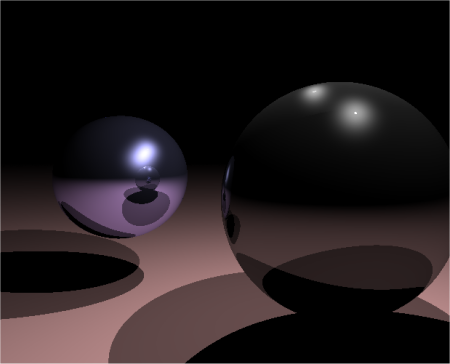
We all hate it when you need to do complicate things to get some shadows, right? Wouldn't it be much easier to turn on shadows like eg. a switch?. Well raytracing IS that simple. Unfortunately it's dead slow.
Here's a description of how it is done sometimes, eg. in Blitz3D:
Do a camerapick on every pixel. If there is a mesh under the pixel, then position a dummy pivot at pickedx, pickedy, pickedz and use EntityVisible to check if the pivot can see the light entity. If the light can be seen, this pixel will not be in shadow, otherwise it will be shaded.
Pretty simple, but it may take a minute or so to compute.
The main bottlenecks in this technic are:
-CameraPick
-EntityVisible
Now, after some heavy brainstorming I had 2 revolutionary, weird and crazy ideas to speed things up:
I replaced Camerapick by something I call "Distance by Fog".
Every mesh in the scene is fullbright and white (may be a temporary state). I added some black fog to the main camera.
Based on some formulas and tricks I was then capable to read a pixels RGB and calculate the 3D position of the underlying mesh from it. It really works with an accuracy of about one pixel.
But EntityVisible, that had to be performed for every picked pixel was still endless slow.
This was exactly where my good ol ICU trick came in handy: I created a mesh containing (in theory) one triangle for every pixel (practically I reduced it to 160*120 Tris for speed reasons). Every Triangle gets its individual Vertex Color (ICU=Identification by Color Uniqueness).
Since I already know the 3D coords of all pixels, given by my homebrew quick camerapick, I only got to position the corresponding Tris at those coords. Now I position a second camera (no fog) at the lights coordinate and take a 6-sided (cubemap) render. Using Readpixelfast it allows me now to determine the visibility of each Triangle, from the viewpoint of the light source. Hence I can check this way if a given Pixel is lit or not.
It really works. There are still many problems to solve:
rounding errors due to the limited range of fog levels. This results in tiny inaccuracies in the determination of the "picked" coordinates. No biggie, unfortunately the tris have to be very small to make sure they won't cover one another and therefor some of them end up under the scenes mesh surfaces and get kind of missed in the ICU check. This is the main problem right tnow.
However, I'm real happy that it works at all. These two tricks are real weird IMHO. Maybe somebody can get more out of it.
One warning: don't expect too much: this ist still very bugous and far away from being useful. It's an experiment, still not finished, maybe some people want to join as long as there is something to explore.
Here's the source:
Here's a description of how it is done sometimes, eg. in Blitz3D:
Do a camerapick on every pixel. If there is a mesh under the pixel, then position a dummy pivot at pickedx, pickedy, pickedz and use EntityVisible to check if the pivot can see the light entity. If the light can be seen, this pixel will not be in shadow, otherwise it will be shaded.
Pretty simple, but it may take a minute or so to compute.
The main bottlenecks in this technic are:
-CameraPick
-EntityVisible
Now, after some heavy brainstorming I had 2 revolutionary, weird and crazy ideas to speed things up:
I replaced Camerapick by something I call "Distance by Fog".
Every mesh in the scene is fullbright and white (may be a temporary state). I added some black fog to the main camera.
Based on some formulas and tricks I was then capable to read a pixels RGB and calculate the 3D position of the underlying mesh from it. It really works with an accuracy of about one pixel.
But EntityVisible, that had to be performed for every picked pixel was still endless slow.
This was exactly where my good ol ICU trick came in handy: I created a mesh containing (in theory) one triangle for every pixel (practically I reduced it to 160*120 Tris for speed reasons). Every Triangle gets its individual Vertex Color (ICU=Identification by Color Uniqueness).
Since I already know the 3D coords of all pixels, given by my homebrew quick camerapick, I only got to position the corresponding Tris at those coords. Now I position a second camera (no fog) at the lights coordinate and take a 6-sided (cubemap) render. Using Readpixelfast it allows me now to determine the visibility of each Triangle, from the viewpoint of the light source. Hence I can check this way if a given Pixel is lit or not.
It really works. There are still many problems to solve:
rounding errors due to the limited range of fog levels. This results in tiny inaccuracies in the determination of the "picked" coordinates. No biggie, unfortunately the tris have to be very small to make sure they won't cover one another and therefor some of them end up under the scenes mesh surfaces and get kind of missed in the ICU check. This is the main problem right tnow.
However, I'm real happy that it works at all. These two tricks are real weird IMHO. Maybe somebody can get more out of it.
One warning: don't expect too much: this ist still very bugous and far away from being useful. It's an experiment, still not finished, maybe some people want to join as long as there is something to explore.
Here's the source:
; Realtime Shadow Raytracing Approach by Dieter Marfurt
; This Demo is using the ICU Method (Identification by Color Uniqueness) to
; determine what pixel blocks are lit by the light source.

; it also replaces slow Camerapicks by a weird Technic named "Distance by fog".

; This demo is far from being ready to be used in a game etc. Noless it shows that
; there may be a way to do fast realtime raytraced shadows very similar to pixel shaders
; in software.

; Maybe someone's gonna pick it up and make something useful out of it.

Graphics3D 640,480,32,2
;Graphics3D 320,240,32,2
SetBuffer BackBuffer()

Global screenwidth=GraphicsWidth()
Global screenheight=GraphicsHeight()

Global screen_bk=CreateImage(screenwidth,screenheight)


; By now the amount of shading elements is reduced to 160*120, mainly for speed reasons
; (When this is increased then the ICU encoding should be edited as well because now it's
; using the lower 2 bytes of the RGB colors to encode X and Y)
Global tow_w=159,tow_h=119
Global tow_whalf#=tow_w/2.0,tow_hhalf#=tow_h/2.0
Global tow_wrel#=GraphicsWidth()/(tow_w+1),tow_hrel=GraphicsHeight()/(tow_h+1)
Dim buf(tow_w,tow_h)
Dim grey(tow_w,tow_h)


; main cam, also used for distane by fog check
Global cam=CreateCamera()
TranslateEntity cam,0,0,-8
CameraFogMode cam,1
CameraFogColor cam,0,0,0
CameraFogRange cam,0,25.5
CameraProjMode cam,1

; cubemap cam for ICU check
Global raycam=CreateCamera()
CameraViewport raycam,0,0,tow_w,tow_h
CameraRange raycam,0.001,256
CameraProjMode raycam,0


; some meshes
middle=CreatePivot()
num=2
Dim obj(num)
For i=0 To num
 obj(i)=CreateCylinder()
 ScaleEntity obj(i),Rnd(.2,.5),Rnd(1,2),Rnd(.2,.5)
 EntityPickMode obj(i),2
 PositionEntity obj(i),Rand(-3,3),Rnd(1,2),Rand(-3,3)
 RotateEntity obj(i),Rand(360),Rand(360),Rand(360)
 EntityParent obj(i),middle
 EntityFX obj(i),1 Or 16
Next

ground=CreateCube()
ScaleEntity ground,4,0.2,4
TranslateEntity ground,0,-2,0
EntityPickMode ground,2
EntityFX ground,1


Global dummy=CreatePivot() ; helper pivot


Global light=CreateLight(2)
PositionEntity light,0,30,0 ; dynamic light


; Single Surface Mesh using VertexColor for ICU method
Global tow_mesh=CreateMesh()
Global tow_surf=CreateSurface(tow_mesh)
Global di#=0.1 ; this will be the size of the ICU tris! should not be too small or too big.
For j=0 To tow_h
 For i=0 To tow_w
  v0=AddVertex(tow_surf,di*i		,di*j		,0)
  v1=AddVertex(tow_surf,di*i+di		,di*j		,0)
  v2=AddVertex(tow_surf,di*i		,di*j+di	,0)
  VertexColor tow_surf,v0,0,j+10,i+10 ; set ICU colors (max 245*245 by now)
  VertexColor tow_surf,v1,0,j+10,i+10
  VertexColor tow_surf,v2,0,j+10,i+10
  tri=AddTriangle(tow_surf,v0,v1,v2)
 Next
Next
EntityFX tow_mesh,1 Or 2 Or 16
HideEntity tow_mesh

Color 0,0,0

While KeyDown(1)=0
 t1=MilliSecs()
 For i=0 To num
  TurnEntity obj(i),1,2,3
 Next
 TurnEntity middle,0,-1,0
 TurnEntity ground,0,1,0
 RenderWorld()
 do_shadows()
 t2=MilliSecs()
 Color 0,255,0
 Text 0,0,t2-t1
 Flip
Wend
End


Function do_shadows()
 ; save the rendered screen because we'll perform cubemap rendering on the backbuffer
 CopyRect 0,0, screenwidth, screenheight,0,0,BackBuffer(),ImageBuffer(screen_bk)

 Dim buf(tow_w,tow_h) ; erase sunlight array
 LockBuffer BackBuffer()
 For j=0 To tow_h
  For i=0 To tow_w
   rgb=ReadPixelFast(i*tow_wrel,j*tow_hrel) And $ffffff ; determine distance to object under pixels (by fog brightness)
   grey(i,j)=((rgb Shr 16) +((rgb Shr 8) And $ff)+(rgb And $ff))/3
  Next
 Next
 UnlockBuffer BackBuffer()

 For j=0 To tow_h
  For i=0 To tow_w
   If (grey(i,j)>0)
    ; camerapick replacement (lots faster):
    dis#=(255.0-grey(i,j))/10.0 ; distance calced by fog amount
    PositionEntity dummy,EntityX(cam),EntityY(cam),EntityZ(cam),1
    RotateEntity dummy,EntityPitch(cam),EntityYaw(cam),EntityRoll(cam),1
    xoff#=((i-tow_whalf)*dis/tow_whalf)
    yoff#=-((j-tow_hhalf)*dis/tow_whalf)
    MoveEntity dummy,xoff,yoff,0
    MoveEntity dummy,0,0,dis
    ; dummy is now positioned at the "camerapicks" coordinate
    ; so we put this screencoords ICU triangle there
    VertexCoords tow_surf,TriangleVertex(tow_surf,((j*(tow_w+1))+i),0),EntityX(dummy)-di,	EntityY(dummy)-di,	EntityZ(dummy)-di
    VertexCoords tow_surf,TriangleVertex(tow_surf,((j*(tow_w+1))+i),1),EntityX(dummy)+di,	EntityY(dummy)+di,	EntityZ(dummy)+di
    VertexCoords tow_surf,TriangleVertex(tow_surf,((j*(tow_w+1))+i),2),EntityX(dummy)+di,	EntityY(dummy)-di,	EntityZ(dummy)-di
   Else ; assuming not picked any mesh: move tri out of view.
    VertexCoords tow_surf,TriangleVertex(tow_surf,((j*(tow_w+1))+i),0),16000+EntityX(dummy),		16000+EntityY(dummy),	EntityZ(dummy)
    VertexCoords tow_surf,TriangleVertex(tow_surf,((j*(tow_w+1))+i),1),16000+EntityX(dummy)+di,		16000+EntityY(dummy),		EntityZ(dummy)
    VertexCoords tow_surf,TriangleVertex(tow_surf,((j*(tow_w+1))+i),2),16000+EntityX(dummy),		16000+EntityY(dummy)+di,	EntityZ(dummy)
    buf(i,j)=1
   EndIf
  Next
  If KeyDown(1)=1 Then End
 Next


 ; now we position a non fog camera at the lights coordinate and take 6 renders (cubemap)
 ; whenever a ICU color will appear on the renders, we'll know that "pixel" is lit, where the Color holds the pixel coordinate.

 CameraProjMode cam,0
 CameraProjMode raycam,1
 PositionEntity raycam,EntityX(light),EntityY(light),EntityZ(light),1

 ShowEntity tow_mesh
 w=256 ; size of cubemap, the smaller, the less accurate
 h=256

 ; check every pixels 3d content: can it be seen by the light?
 ; (do this on 6 sides)
 check_icu(0,0,0,w,h)
 check_icu(90,0,0,w,h)
 ;Flip ; used for visual debugging
 check_icu(180,0,0,w,h)
 check_icu(270,0,0,w,h)
 check_icu(0,90,0,w,h)
 check_icu(0,-90,0,w,h)

 HideEntity tow_mesh

 ; restore main render
 CopyRect 0,0, screenwidth, screenheight,0,0,ImageBuffer(screen_bk),BackBuffer()

 darken_shadows2() ;darken shady pixels (blocks by now)

 CameraProjMode cam,1
 CameraProjMode raycam,0
End Function


Function check_icu(pitch#,yaw#,roll#,w,h)
 CameraViewport raycam,0,0,w,h
 RotateEntity raycam,pitch,yaw,roll
 WireFrame 1 ; not sure if this is a good idea...
 RenderWorld()
 WireFrame 0

 LockBuffer BackBuffer()
 For j=0 To h-1
  For i=0 To w-1
    rgb=ReadPixelFast(i,j) And $ffff
    j_=((rgb Shr 8) And $FF)-10 ; decode possible ICU color / coodinate
    i_=(rgb And $FF)-10
    If j_>=0 And j_<=tow_h
     If i_>=0 And i_<=tow_w
      buf(i_,j_)=1 ; ICU detected, sun is shining here!
     EndIf
    EndIf
  Next
 Next
 UnlockBuffer BackBuffer()
End Function


Function darken_shadows2()
 Color 0,0,0
 For j=0 To tow_h
  For i=0 To tow_w
   If buf(i,j)=0 ; no sunshine here?
    Rect i*tow_wrel,j*tow_hrel,tow_wrel,tow_hrel,1 ; paint shadow (well a simple placebo thing)
   EndIf
  Next
 Next
End Function